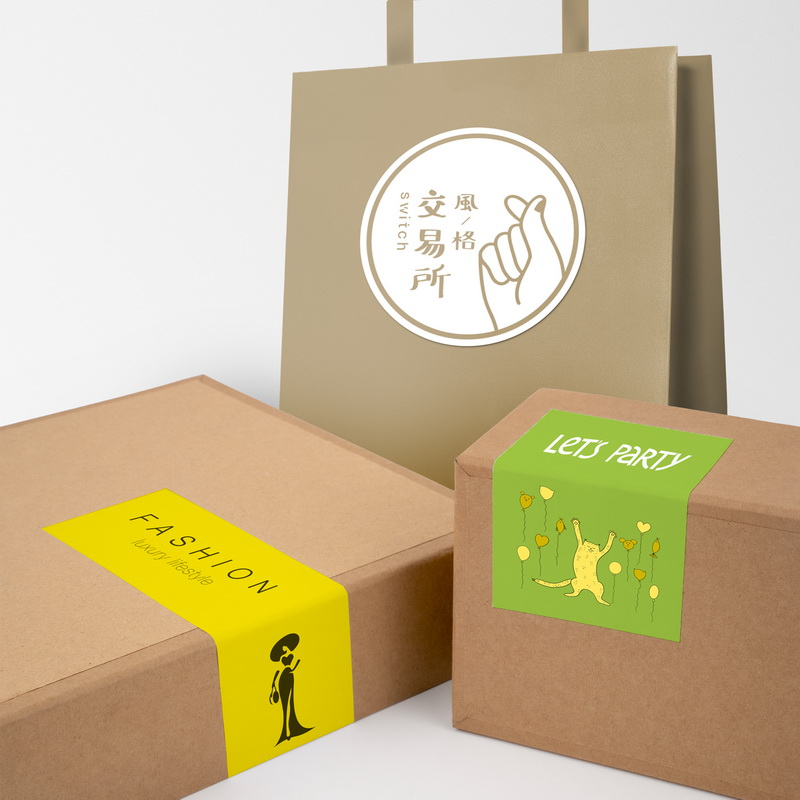
Self-adhesive labels are an essential part of product packaging. They function as branding elements, product instructions, and identifiers that help consumers quickly recognize goods. High-quality label printing not only enhances product appearance but also increases consumer interest and confidence. This article introduces the main printing methods used for self-adhesive labels and compares their characteristics and applications.
Self-adhesive label printing involves transferring text, graphics, or images onto adhesive-backed materials using specific printing processes. Once printed, the label can be peeled and applied to packaging or products for identification and decoration. Common printing methods include letterpress printing, flexographic printing, offset printing, gravure printing, and screen printing.
1. Letterpress Printing
Professional self-adhesive label printing machines primarily use letterpress technology. These machines can print on both paper and film labels. When printing film labels, adjustments may be required, such as:
- Adding a servo-controlled tension system
- Installing film surface treatment components
- Improving registration accuracy
- Adjusting UV curing power
Companies using rotary letterpress presses can also switch from photosensitive resin plates to highly elastic flexographic plates. By changing to water-based or UV flexographic inks, the printing system becomes more compatible with film substrates.
Letterpress printing is particularly suitable for mid-volume paper labels and offers good print clarity.
2. Flexographic Printing
Flexographic printing has developed rapidly and can now achieve quality comparable to offset printing. It also offers unique advantages:
- Simple machine structure
- Lower operating cost
- Thick, vibrant ink layers
- Compatibility with water-based and UV inks
However, flexographic plates are highly elastic, causing greater dot gain. This can lead to reduced contrast and broken highlights when printing fine graphics. To improve tonal reproduction, hybrid screening methods can be used—for example:
- FM dots in highlight areas
- AM dots in midtone and shadow areas
Companies without flexographic presses can invest in narrow-web flexographic machines designed specifically for self-adhesive labels. These machines are excellent for film label production but rely on rotary die-cutting, meaning tooling is expensive and more suitable for long runs rather than short orders.
3. Offset Printing
Offset printing is widely used for paper-based self-adhesive labels. Its advantages include:
- Very fine detail reproduction
- Smooth tonal gradation
- High efficiency for large production volumes
- Versatile equipment configurations
However, traditional sheet-fed offset printing is not suitable for non-absorbent films because it requires inks that dry through evaporation. To print on thick plastic materials, additional UV curing systems must be installed, significantly increasing equipment costs.
Offset printing remains ideal for high-quality paper labels, folded labels, and in-mold label projects where clarity is essential.
4. Gravure Printing
Gravure printing utilizes a short ink path system and is highly efficient for roll-based self-adhesive label production. Its key characteristics include:
- High automation
- Fast drying solvent-based inks
- Excellent suitability for film substrates
- High production speed
- Integration with die-cutting and creasing units
Because gravure cylinders are costly and require a long plate-making cycle, gravure printing is best suited for large-scale, continuous label production.
5. Screen Printing
Screen printing is one of the most versatile printing techniques. Many printing companies rely on cost-effective screen printing equipment to produce both paper and film self-adhesive labels.
Benefits include:
- Very rich ink layers
- Strong tactile and visual effects
- Excellent performance with UV inks
- Suitable for specialty labels and decorative effects
However, most screen printing machines are semi-automatic flatbed systems. They print single sheets, have lower registration accuracy, and are not suitable for high-speed roll-to-roll film label production lines.
Post-Printing Considerations
After printing, self-adhesive labels require different finishing methods depending on whether they will be used as:
- Sheets (for manual application)
- Rolls (for machine application)
When switching printing technologies, companies must also adjust their finishing processes to ensure compatibility with label application equipment and production requirements.