China’s self-adhesive label industry originated in coastal regions such as Guangdong and Tianjin, where early production equipment was imported from Japan. As label technology spread nationwide, China’s printing capabilities and production technologies matured rapidly. Today, self-adhesive labels have become a booming sector, attracting manufacturers from multiple industries to enter the market.
I. Overview of China’s Self-Adhesive Label Market
China’s label industry is still at a developing stage. Currently:
- China’s self-adhesive label market is approximately 450–500 million m².
- Average per capita usage is only 0.3 m² per year.
- Guangdong + Hong Kong account for 67% of the total domestic market.
- Shanghai is projected to become a leading market in the next 4–5 years.
China’s label market still has significant untapped potential, and demand is growing across multiple industries.
II. Main Application Fields of Self-Adhesive Labels
Self-adhesive labels are applied across five major categories:
- Decoration
- Information
- Identification
- Anti-counterfeiting
- Storage & transportation
Widespread end-use industries include:
- Daily chemical & cosmetic products
- Electronics & home appliances
- Pharmaceuticals
- Food & beverage
- Logistics & supermarkets
- Industrial and safety applications
- Anti-counterfeiting labels
- Eco-friendly product packaging
Among these, four industries show the strongest growth:
1. Daily Chemical Industry (Largest Demand Segment)
- Accounts for over 30% of the total label market demand.
- Nearly 40% of packaging materials use self-adhesive labels.
- Products such as detergents, shampoos, home-care liquids rely heavily on durable, moisture-resistant labels.
2. Electronics & Electrical Appliances
- Used for large-area instruction labels, safety warnings, nameplates, and logistics tracking.
- Rapid growth of IT products (computers, communication devices) continues to expand demand.
3. Pharmaceutical Industry
- Emphasis on hygiene, clarity, and tamper-evident packaging.
- Transition from traditional paper labels to self-adhesive pharmaceutical labels is accelerating.
4. Logistics & Retail
- High demand for variable information labels (VIP labels):
- Shipping labels
- Storage/warehouse labels
- Supermarket labels
- Baggage tags
Modern logistics relies heavily on barcode and QR-code label systems.
III. Development Trends of Self-Adhesive Labels in China
China’s self-adhesive label industry is evolving in several key directions:
1. High-Speed Production
- Increased order volume and competitive pressure require faster printing speeds.
- Centralized mass production must maintain consistent quality while increasing efficiency.
2. Refined and Attractive Designs
- Labels must carry more product information and visual appeal.
- Brands demand high-end decorative effects and premium finishes.
3. Personalized & Diverse Label Forms
Modern labels are:
- More three-dimensional
- Available in various shapes
- Integrated with scratch-off features
- Designed for varied promotional applications
4. Increased Technological Content (Smart & Anti-Counterfeiting Labels)
- RFID smart labels replacing barcodes
- Applications in logistics, retail, toll collection, baggage systems
- Anti-counterfeiting technologies include microprinting, holographics, and multi-layer materials
IV. Flexographic Printing: Driving the Industry Forward
Flexographic printing has become a major contributor to high-quality label production. Its strengths include:
- High resolution and image detail
- Compatibility with UV inks for better gloss and durability
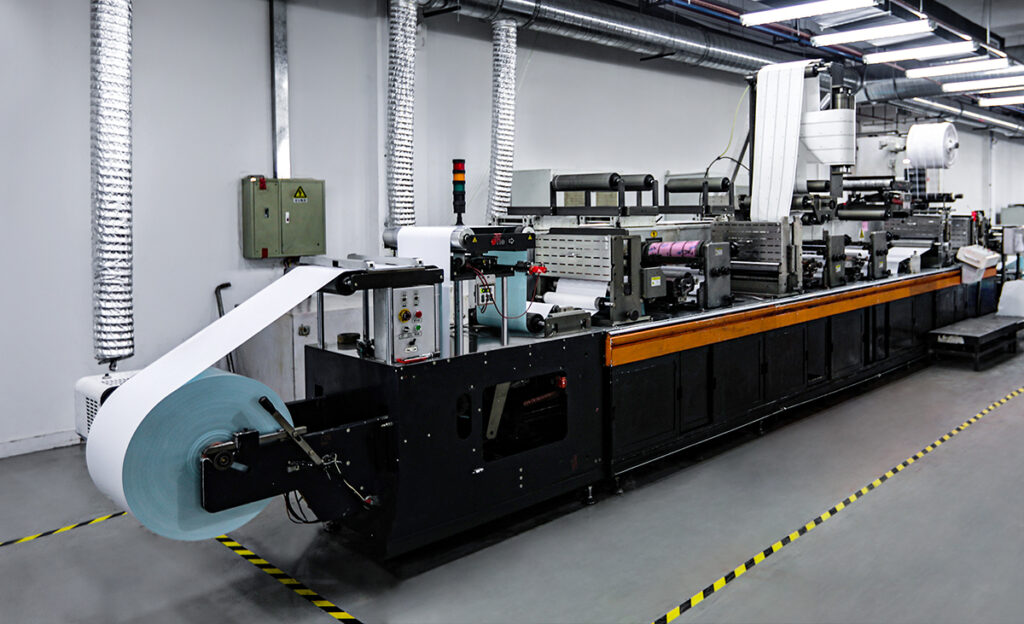
- Inline processing (printing + varnishing + foil stamping + die-cutting)
- Consistent color management
Compared with traditional printing:
| Improvement | Effect |
|---|---|
| From monochrome → multicolor | Richer, more detailed designs |
| Paper → film & specialty materials | More durable, moisture-resistant |
| Solvent inks → water-based & UV inks | More eco-friendly |
| Multi-step → one-pass processing | Higher efficiency & accuracy |
| Single-function machine → multi-function machine | More diverse label effects |
V. Competitive Landscape in China’s Label Market
The industry includes:
- Foreign-invested enterprises
- State-owned enterprises
- Private/township enterprises
1. Foreign-Invested Enterprises
Advantages: advanced equipment, stable quality, strong capital, robust service.
2. State-Owned Enterprises
Strengths: solid foundation, advanced equipment, undergoing transformation.
3. Private Enterprises
Characteristics: wide distribution, large market share, but uneven quality and weaker innovation.
4. Grey-Channel Imported Materials
Low price but poor stability; long-term unsustainable.
VI. Four Major Dimensions of Market Competition
1. Product Competition
- Raw material stability
- Coating quality
- Face stock, adhesive, and liner performance
- R&D capabilities for expanding application fields
2. Service Competition
- Pre-sales technical support
- Fast delivery and distribution systems
- Value-added services (longer rolls, fewer joints, custom solutions)
3. Brand Competition
- Professionalism of technical teams
- Industry reputation
- Customer trust and long-term partnerships
4. Speed & Efficiency Competition
- Faster response to market needs
- Agile supply chain
- Rapid sample/testing capability
- Efficient production and development
Companies that can deliver both speed + quality will hold the competitive advantage.